Quiet Day Mediations
Delivered at the Advent Quiet Day 6 December 2025
Quiet Day Mediation
6 December 2025
To be read slowly and without imparting emotion or meaning.
A Reading from the Gospel of St. Matthew (3:1-12):
In those days came John the Baptist, preaching in the wilderness of Judea, 2 “Repent, for the kingdom of heaven is at hand.” 3 For this is he who was spoken of by the prophet Isaiah when he said,
“The voice of one crying in the wilderness:
Prepare the way of the Lord,
make his paths straight.”
4 Now John wore a garment of camel’s hair, and a leather girdle around his waist; and his food was locusts and wild honey. 5 Then went out to him Jerusalem and all Judea and all the region about the Jordan, 6 and they were baptized by him in the river Jordan, confessing their sins.
7 But when he saw many of the Pharisees and Sad′ducees coming for baptism, he said to them, “You brood of vipers! Who warned you to flee from the wrath to come? 8 Bear fruit that befits repentance, 9 and do not presume to say to yourselves, ‘We have Abraham as our father’; for I tell you, God is able from these stones to raise up children to Abraham. 10 Even now the axe is laid to the root of the trees; every tree therefore that does not bear good fruit is cut down and thrown into the fire.
11 “I baptize you with water for repentance, but he who is coming after me is mightier than I, whose sandals I am not worthy to carry; he will baptize you with the Holy Spirit and with fire. 12 His winnowing fork is in his hand, and he will clear his threshing floor and gather his wheat into the granary, but the chaff he will burn with unquenchable fire.”
The Wilderness
This is the Wilderness of Judea. Not a pleasant place. Not a green place. A place that appears as if God used brown scale to 3D print an unpleasant land. The few trees that grow are not much larger than bushes as they seek to conserve the small amount of moisture they receive each year. Other vegetation eeks out an existence as close to the ground as possible, that it might receive the scant dew, and be preserved from the scorching heat of the sun and the freezing cold of the moon.
It is a land that is composed of sharp ridges on brown mountains. A land where these same hills are cut by the remnants of streams, but are now mostly dry wadis. And while there are springs in remote places, they are mostly hidden, and the weary travelers, or the small deer that somehow find a way to live in this place, are usually overwhelmed by thirst when they come upon one.
A truly dry and thirsty land.
This is not the wilderness that the tribes of Israel wandered in for forty years. This is not the wilderness that holds Mt. Sinai, the Mountain of the Lord. This is not the wilderness where God provided Manna and Water, and even slaked the gluttonous need for meat with an impressive covey of Quail. That is another wilderness.
This is the Wilderness of Judea. The wilderness named after the Tribe of Judah and well within the territory of that ancient inheritance. It is the wilderness of a people. It is our wilderness. This is the wilderness of Dave, the wilderness of “insert your name here”.
It is a wilderness of the desert times of our lives. This is the wilderness of our dryness. We have become the trees whose growth is stunted from lack of moisture and from self-protection. We have become the grasses that are withered, and whose flower has faded, because the dew that once watered the ground in the garden of Paradise no longer reaches us, and we struggle under the heat of life or the crushing cold of spiritual night.
We have become hard like the flint rocks of the hills. We bear the scars of the once mighty waters that flowed, but now are just the dry streams of the desert with barely a trickle of that water of life flowing through us. We have a memory of the time when grace and peace flowed like a river, but that seems to be in the distant past.
We are like the deer who eagerly seeks the life-giving spring, who pants after the water-brooks, the traveler whose tongue cleaves to his mouth in this most inhospitable land. We like the land have become inhospitable.
Dry and thirsty.
Yet, paradoxically, it is in the wilderness that God is so often met, where he chooses to meet His people and supply their needs. God comes to the Wilderness, the Wilderness of Judea, and our own personal wilderness, the wilderness we have become. Here in the wilderness, we pray that God will make himself known.
Let us take time to explore our own wilderness. Prayerfully consider where your life is wilderness and offer this to God. I will ring the small bell and offer a concluding prayer after a period of time.
Prayer: God of our Fathers and Mothers, you call and find your people in the wilderness. Accept the offering of our own wildernesses, and meet us as you met Moses, Elijah, and John, and the Children of Israel. Take our wilderness and send the dew of your presence that we might bloom and be healed even in the desert of our lives. Let us always trust in your love, and find you who calls us Sons and Daughters. Through Christ, the Living Water, we pray. Amen.
Straight Paths
It was different wilderness. This time in the Andes of Argentina. A high desert valley with a rushing river running through it fresh with the melting snow of spring coming off the peak of Aconcagua in the distance. A stunning sight. I had come to conquer this mountain with its 22000-foot summit.
This morning was to start at 8000 feet, make a simple three-mile trek up the valley, or rather on its shoulders to the camp that sat at a bit over 11000 feet. Not a difficult ascent and only a three-mile distance. That is, of course, if you could fly like an eagle or an Andean Condor. Even without being gifted with wings it was to be a short day on the trail, a mere three hours start to finish, a simple five miles on the trail.
I had trained for this day. I had experience on other mountains in remote locations. None of this was new to me. The distance was not much more than my daily walks. I had climbed countless stairs and bleachers and was used to my pack. I settled my pack perfectly on my shoulders with the weight placed comfortably on my hips. I took my trekking poles in my hands and laughing and conversing with my friends started this easy day.
That was the beginning, and it did not end as planned.
A mere half a mile into the trek, I knew something was wrong. I had not even come to the bridge over the river that marked the true beginning of the trekking path when my thighs began to burn with each step of ascent and descent. My hip flexors began to tremble and “scream” each time they were called upon to work. At this time, I did not give voice to complaint, but simply trudged on, across that bridge in company of my friends.
After a brief pause to take a picture together, and to adjust our packs, we set off again. Into the rocky desert. We would not be stopped, and we had the trail to ourselves. And so we went up. I paused to rest. My friends stopped with me. This was not going as I expected. We started again, this hill was simply a 100-foot gain of elevation and reaching the top, I was glad to see that we would descend a bit before the next hill. Of course, none of these climbs and descents were straight paths, rather, each was composed of a series of “switchbacks” like the mountain roads we have all driven.
The next ascent was when the pain really began. It was a fight to keep walking, to keep moving. My watch warned me that my heart rate was starting to get to the max point for my health. I needed to stop. I needed to rest. I needed to stretch and recover. I knew that my friends would stay with me, but I was holding them up. As an accomplished trekker, I was not concerned about finding the trail and the camp, and so told them to go on ahead and that I would be close behind them.
Not true. As I struggled to follow, they would look back and check on me, and I could see them progressing higher up the valley. Then the trail ran out and the markings stopped. This was the end of the day tripper walk, where visitors on tours stopped to get their photos of the mountain and their selfies.
While not lost, the worn paths of other trekkers to the mountain diverged in different directions. As if each had found their own way to the base camp. I began to have to pick my way through the rocks and the creek beds. Often, I would take a wrong “path” only to come across a rock wall, or a ravine that either necessitated a scramble down one side and up the other, meaning I either had to tackle the more difficult terrain or to retrace my steps to find a more convenient crossing.
Falling. Sliding. Pain. Suffering. Weight.
The pack became heavier, even at a mere twenty-six pounds. It became an exercise of determination and suffering. Counting steps to push through a bit more and taking frequent stops. Praying for strength. Praying that I might find the right path.
Seconds seemed like minutes and minutes like hours. Three hours eventually became six.
A switchback here. A wrong turn there. A fall. A scramble a climb. Finally, I turned the corner and could see the camp at the end of a “flat” valley though still gaining elevation.
A half mile from the camp I saw two young rangers coming down the trail. They had been sent by my worried friends to find me. They did. Worn out and frazzled. They were to escort me to the camp and the medical tent. One offered to take my pack. In pride, I refused and carried that weight onward. No, do not help me carry this burden. I will do it.
The wilderness does not contain straight paths, and our burdens become heavier as we wander. The promise of God is that He will make straight the paths. He will take our burdens. He will find us when we are lost. When we are weak, He will be our strength.
What paths do we walk today? Are we lost? Have we missed the signs of the trail and gotten ourselves into places that block us? Have we come, on our own volition, to places of great difficulty? Where do we need to allow God to work that our path may be straightened? Has our pride gotten in the way of our release?
Let us take to examine the paths of our lives and pray that God will show us the straight path and provide it for us. Let us offer the heavy burdens that we carry in our “packs” to God. Let us ask God also how we can share the burdens of others.
Concluding prayer: Almighty God, whom truly to know is everlasting life: Grant
us so perfectly to know your Son Jesus Christ to be the way, the truth, and the life, that we may steadfastly follow his steps in the way that leads to eternal life; through Jesus Christ your Son our Lord, who lives and reigns with you, in the unity of the Holy Spirit, one God, for ever and ever. Amen.
Repent
Our Anglican heritage has always placed great emphasis on the need of God’s people to repent. In the traditional language of the Book of Common Prayer the invitation to repentance begins, “Ye who do truly and earnestly repent you of your sins and are in love and charity with your neighbor and intend to lead a new life, following the commandments of God and walking from henceforth in his holy ways, draw near with faith and make your humble confession to Almighty God, devoutly kneeling.”
Yes, this is an invitation.
So often, when we hear the words of John the Baptist, or even our own preachers, we hear the call to Repent as a command as if it bears all the weight of judgment and destruction. It falls on our ears as a negative word instead of a call to hope and forgiveness, a way to life and freedom rather than wrath. Yet, it has not always been so, and our liturgical tradition calls us to see this repentance in a different light, to as the word repent means, “have a new mind”.
The first option for confession in The Holy Eucharist Rite I has us recite that, “we are heartily sorry for our misdoings, the remembrance of them is grievous unto us.”
The remembrance is grievous. What does it mean to have a remembrance that is grievous? Grievous comes to us from the term grief, and is defined as causing great pain, such as grievous wounds that have a very serious effect on the body. Here we are invited to enter into the reality that sin, and our participation, in it, causes these very serious wounds to our soul, and to the world. Yet, it is not simply the effect of the sin that is grievous, but that in our very remembrance of them we find the sting remaining as if the wound caused by that sin is still open and suppurating. We are asking not just for a “clean ledger” but that the would itself be cleaned, cauterized, bandaged, healed.
The confession continues, “, the burden of them is intolerable.” The image that comes to my mind is of an old porter who has been struggling under the weight of all that has been placed upon his shoulders. He has begun to break under the strain and one more thing will cause his knees to buckle and him to fall and to be crushed, even unto death.
Thus, we each carry the weight of sin upon the backs of our souls and are asking that we be relieved of all that presses upon us and presses us closer to the earth and the grave. We know we can tolerate much, but in our moments of honesty, we know that sin lies weighty upon our shoulders and we cannot bear it another step.
Perhaps a more fitting image is found in the Stations of the Cross, where our Lord falls three times under the weight of the hard wood upon which he will stretch out his arms for us. For he has carried our burdens, and tolerated that which became intolerable for us.
Or maybe the words of the old confession from Morning Prayer in the 1928 Book of Common Prayer, “And there is no health in us” will serve to further illustrate. Here the Book of Common Prayer confirms, and conforms to, the ancient Christian understanding that Sin itself is a disease that resides in us. Not simply a moral failure, or a legal violation, but something deeper and more hideous. A sort of spiritual cancer if you will that if left unchecked will destroy us and bring us to death.
If this is true, then what does a person with cancer need? Judgment? Condemnation?
No, treatment by a physician who understands their sickness and knows how to treat and bring healing.
Not one of us would hesitate to bear our wounds and symptoms to our earthly physician. Not one of us would hesitate to listen to their counsel. Not one of us would hesitate to allow them to stitch and bandage a bleeding gash. Not one of us would hesitate to take a prescription offered.
So why do we hesitate to come to the great Physician of our souls who can apply the treatment that brings life-giving healing. He is both the physician and the balm that is applied and brings healing to our grievously wounded soul. His is the blood that is shed for the “remission of sins,” the remission of our spiritual cancer.
And so, the call to repentance is not simply a negative command, but an invitation to know the “healing power of His love”, to partake in that spiritual medicine that binds up our wounds like the Good Samaritan.
For He loves us and desires us to enter into his healing, to come and confess our sickness, and receive the precious renewal, to have a new mind, filled with the love of and for God, and focused on His way. To follow the prescription of his commandments, which are the way of Life and Salvation.
Let us hear anew, the invitation to repent on Page 331 of the Book of Common Prayer and in the silence that follows bring our wounds, our grievous memory of sin, the intolerable burden to Him who loves us and desires that we be healed.
Invitation to Confession
Pause
Confession
Absolution
Baptized in Water and the Spirit
As we come to the conclusion of our time of mediation, I offer this short reminder.
John states that he is baptizing with water and the One who is coming will baptize with the Holy Spirit and Fire.
Each of us who has gone through the Waters of Baptism and Confirmation/Chrismation has been raised with Christ and marked as his own forever. In Chrismation, we receive the outward anointing which symbolizes the reality that each of us is a recipient of John’s prophecy. We have received the Holy Spirit.
As Adam was made a living soul by the breath of God, so the breath of the Holy Spirit makes us alive and animates us as Sons and Daughters of God.
The Holy Spirit who descended on Pentecost as of tongues of fire is in us, and desires to continue to burn within us. Fire, of course, can purify or destroy. We who are in Christ are called to let the Holy Spirit purify us and burn away all that is not worthy of Christ and his Kingdom.
Let us pray for the renewal of the Holy Spirit in our lives.
Conclude:
Come, Holy Ghost, our souls inspire,
and lighten with celestial fire.
Thou the anointing Spirit art,
who dost thy sevenfold gifts impart.
Thy blesséd unction from above
is comfort, life, and fire of love.
Enable with perpetual light
the dullness of our blinded sight.
Anoint and cheer our soiled face
with the abundance of thy grace.
Keep far our foes, give peace at home:
where thou art guide, no ill can come.
Teach us to know the Father, Son,
and thee, of both, to be but One,
that through the ages all along,
this may be our endless song:
praise to thy eternal merit,
Father, Son, and Holy Spirit.
Amen.
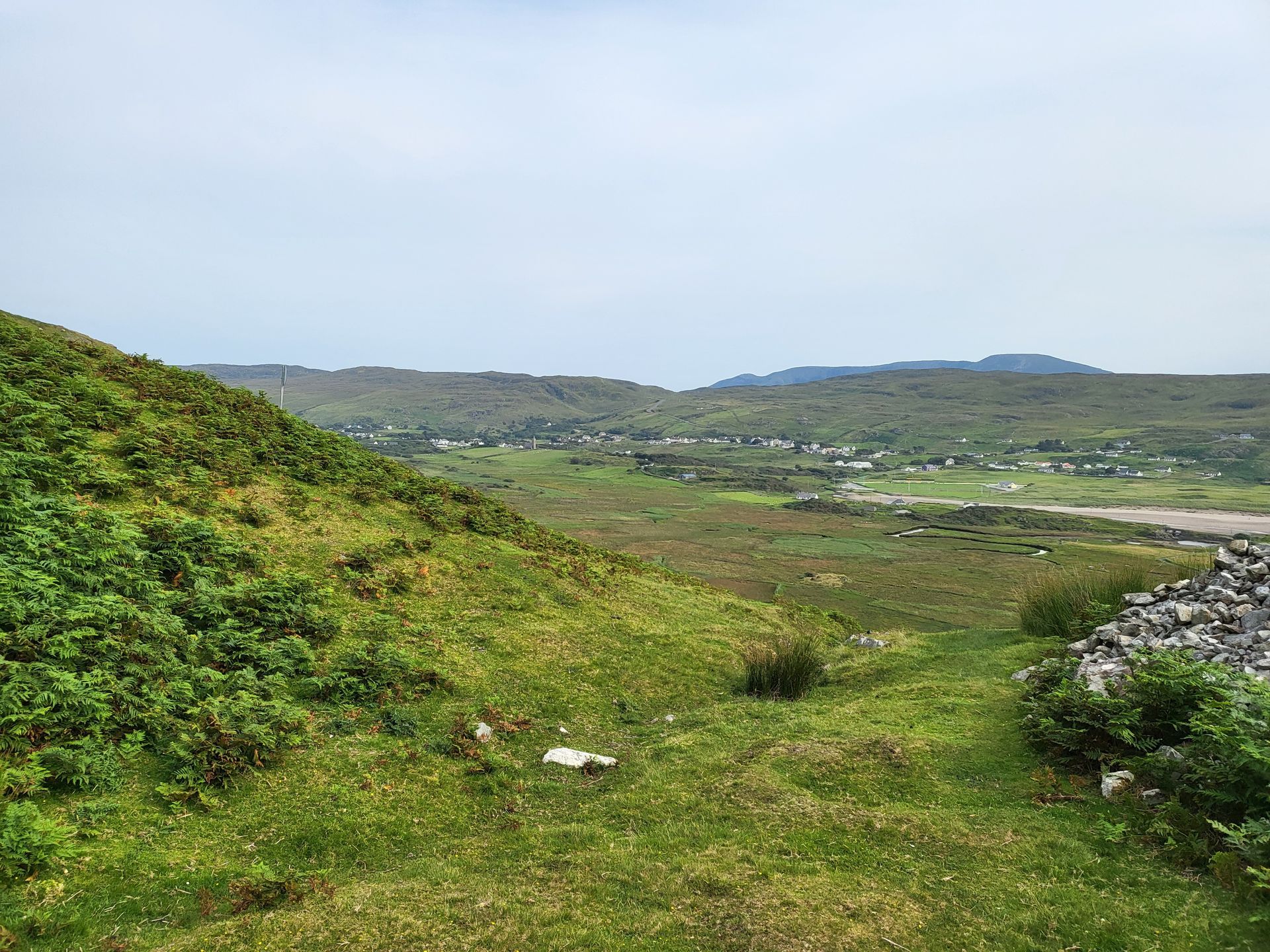
A View from the Mountain